Cartea "Convergence in Shareholder Law"
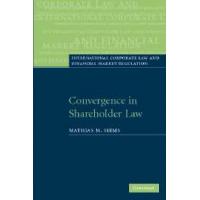

On the one hand, it can be argued that the increasing economic and political interdependence of countries has led to the convergence of national legal systems. On the other hand, advocates of the counterhypothesis maintain that this development is both unrealistic and unnecessary. Mathias Siems examines the company law of the UK, the USA, Germany, France, Japan and China to see how this issue affects shareholder law. The author subsequently analyses economic and political factors which may or may not lead to convergence, and assesses the extent of this development. Convergence of Shareholder Law not only provides a thorough comparative legal analysis but also shows how company law interconnects with political forces and economic development and helps in evaluating whether harmonisation and shareholder protection should be enhanc
Convergence in Shareholder Law
On the one hand, it can be argued that the increasing economic and political interdependence of countries has led to the convergence of national legal systems. On the other hand, advocates of the counterhypothesis maintain that this development is both unrealistic and unnecessary. Mathias Siems examines the company law of the UK, the USA, Germany, France, Japan and China to see how this issue affects shareholder law. The author subsequently analyses economic and political factors which may or may not lead to convergence, and assesses the extent of this development. Convergence of Shareholder Law not only provides a thorough comparative legal analysis but also shows how company law interconnects with political forces and economic development and helps in evaluating whether harmonisation and shareholder protection should be enhanced.
• Includes a description of the company law in six major jurisdictions in one accessible source • Explains the political and economic context of shareholder protection, allowing reader to understand how company law interconnects with political forces and economic development, in particular in the context of ‘globalisation’ • Typological approach to shareholder protection provides deeper understanding than the mere compilation of legal rules.
Contents
Introduction; Part I. The Object and Course of the Investigation: 1. Dimensions of convergence in shareholder law; Part II. The Status Quo of Convergence: 2. Legal bases; 3. Bases for a shareholder typology; 4. The 'Shareholder as Such'; 5. The shareholder in the power structure of the company; 6. Conclusions of Part 2; Part III. Developmental Trends and Patterns: 7. Bases; 8. Convergence through congruence; 9. Convergence through pressure; 10. Future convergences in shareholder law; 11. Conclusions of Part 3; Part 4. Conclusion: 12. Convergence as a model for the future; 13. Summary of principal findings.
Nu uitati sa consultati si sectiunea de carti electronice (eBooks - de pe cele mai populare siteuri) de mai jos!

57 de tehnici, formulare si exemple practice pentru evaluarea si dezvoltarea profesionala a angajatilor CD

Abonament portal Fisa-Postului.ro

Acordarea tichetelor cadou, de masa si de cresa in 47 studii de caz CD

An International Approach to the Interpretation of the United Nations Convention on Contracts for the International Sale of Goods (1980) as Uniform Sales Law

An Introduction to International Criminal Law and Procedure

An Introduction to International Criminal Law and Procedure

Audio-visual Coverage of Courts

Biodiversity Conservation, Law and Livelihoods: Bridging the North-South Divide

Boilerplate

Boilerplate

Capital Markets Law and Compliance

Casatoria in legislatia Romaniei si a Republicii Moldova
Cu ce ai ramas citind aceasta carte?
 Carti electronice - eBooks

 Cartea pe care o cauti
Partenerul saptamanii
Cartea pe care o cauti
Partenerul saptamanii
 Categorii
- Alimentatie
- Arta
- Agricultura
- Studii
- Manuscrise
- Educatie
- Arta razboiului
- Harti
- Antropologie
- Beletristica si critica
- Atlase
- Carti straine
- Calculatoare
- Astronomie
- Autoevaluare
- Consilier
- Botanica
- Carti pentru copii
- Decoratiuni
- Casa si gradina
- Crestinism
- Cultura
- Toate categoriile
 Edituri
- 100+1 GRAMAR
- ACADEMIA CIVICA
- AD LIBRI
- ADANTIS
- AGAPE
- AGATA
- AION
- ALBASTRA
- ALBATROS
- ALCOR - EDIMPEX
- ALETHEIA
- Toate editurile
TipografiiRecomandari